

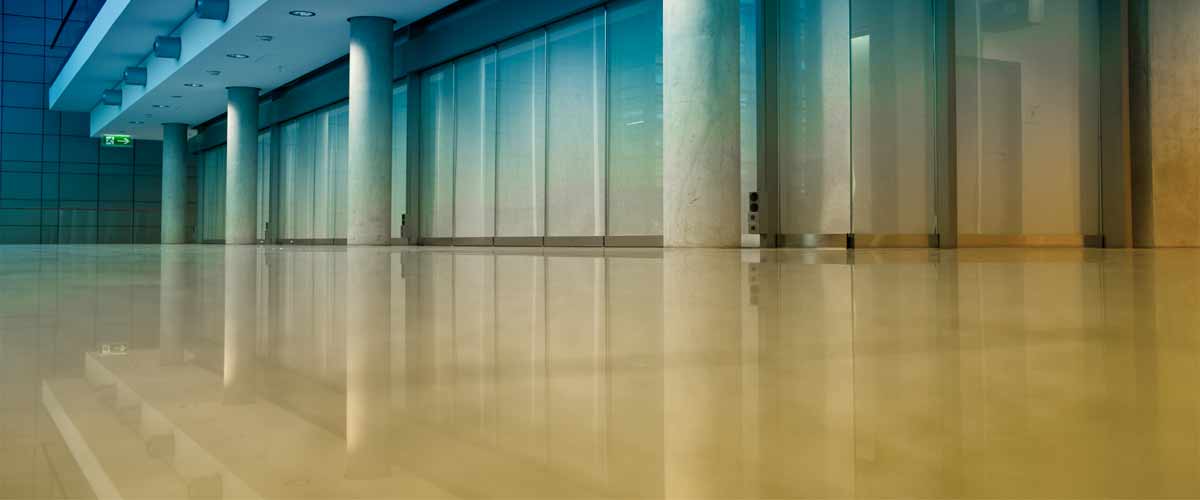
Is Polished Concrete Slippery?
It is one of the most common questions we hear from homeowners and business owners across Miami-Dade and Broward County before they commit to polished concrete: will this floor turn into a hazard the moment it gets wet? The honest answer is that polished concrete can be made just as slip-resistant as any other flooring option, but only if the finish and any coatings are specified correctly for the space.
Polished Concrete Is Not Inherently Slippery
A properly polished concrete floor is not slick like glass. The mechanical polishing process (grinding the surface with progressively finer diamond abrasives) leaves a dense, smooth surface, but “smooth” and “slippery” are not the same thing. Traction depends far more on the coefficient of friction of the finished surface and, critically, on whether the floor is wet, than on how glossy it looks.
Where the Slip Risk Actually Comes From
Most slip complaints on concrete floors trace back to one of three things: a topical sealer or wax that was applied too glossy for the environment, water or grease sitting on the surface without a slip-resistant additive in the finish, or a floor that was polished to a very high gloss level in a wet-prone area like a kitchen, entryway, or pool deck without accounting for that use.
How We Control Slip Resistance in Miami-Dade & Broward
Florida’s humidity, frequent rain, and pool-adjacent living mean slip resistance is a real design consideration here, not an afterthought. For any floor with meaningful wet exposure (bathrooms, kitchens, garages, pool decks, commercial entryways), we adjust the specification rather than leaving it to chance:
— Lower, satin-level gloss instead of a high-gloss polish in wet-prone areas.
— Slip-resistant additives blended into sealers and epoxy topcoats where water exposure is expected.
— Textured or matte finishes for pool decks and exterior walkways, where a high-gloss look would be the wrong call regardless of how it photographs.
— ASTM/ANSI slip-resistance ratings used to guide the finish selection on commercial jobs where code or insurance requires documentation.
What About Epoxy Floors?
The same logic applies to epoxy garage floors and epoxy coatings in general. A smooth, high-gloss epoxy can be slippery when wet, which is exactly why garages, patios, and pool decks in our area are usually finished with a decorative flake broadcast or an aggregate additive that adds texture underfoot without sacrificing the look.
Our Recommendation
Tell us how the space is actually used before we finalize a finish. A formal living room, a showroom floor, and a pool deck all call for different gloss and texture levels, even if the base material is the same polished concrete or epoxy system. Getting this right up front is far cheaper than adding a slip-resistant topcoat after the fact.
Frequently Asked Questions
Is polished concrete safe for a home with kids or elderly family members?
Yes, when the finish is matched to the room. We typically recommend a satin or matte-level polish with a slip-resistant sealer additive for family living areas, kitchens, and bathrooms rather than a high-gloss showroom finish.
Can an existing polished concrete floor be made less slippery?
In most cases, yes. A slip-resistant sealer or additive can often be applied over an existing polished floor without regrinding the entire surface, though the right approach depends on the current finish and condition.
Is polished concrete a good choice for a pool deck in Florida?
It can be, but only with a textured or matte finish designed for wet, barefoot traffic. A high-gloss polish is the wrong specification for a pool deck; ask us about our exterior and pool deck finish options.
Have a specific space in mind? Check our full FAQ or call us to talk through the right finish for your floor.